




Anatomy
The prostate is a gland in the male reproductive system. It lies just below the bladder (the organ that collects and empties urine and in front of the rectum (the lower part of the intestine). It is about the size of a walnut and surrounds part of the urethra (the tube that empties urine from the bladder). The main purpose of the prostate is to produce fluid for semen, which transports sperm during the male orgasm.
The prostate gland consists of several different sections
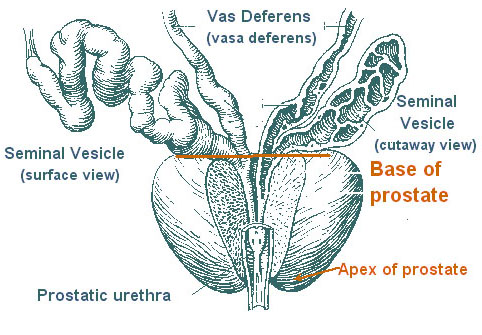
- The base, which is directed upward near the inferior surface of the bladder. The greater part of this surface is directly continuous with the bladder base.
- The apex, which is directed downward and is in contact with the superior fascia of the urogenital diaphragm.
- The Prostate also has anterior, posterior, and lateral surfaces.
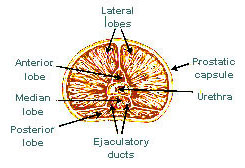
Lobes of the Prostate
- Anterior lobe: Lying in front of the urethra. It is devoid of glandular tissue and formed completely of fibromuscular tissue.
- Median lobe: A cone-shaped portion of the gland situation between the two ejaculatory ducts and the urethra.
- Lateral lobes (right and left): Form the main mass of the gland and are continuous posteriorly. They are separated by the prostatic urethra.
- Posterior lobe: The postero-medial part of the lateral lobes that can be palpated through the rectum during digital rectal exam (DRE).
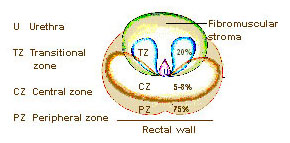
Zones in the Prostate
The prostate is divided into several different zones, according to their function. These zones are important for understanding prostate health and diseases, including prostate cancer.
- Peripheral Zone (PZ): The outermost region, encompassing the posterior and lateral areas of the prostate. This is the zone that is next to the rectum and is palpated during a DRE.
- Central Zone (CZ): Cone-shaped, surrounding the ejaculatory ducts, with its base at the prostate’s base. The seminal vesicles pass through this zone and into the urethra.
- Transitional Zone (TZ): Surrounds the prostatic urethra, making up about 5% of the glandular tissue and contains mucosal glands.
- Anterior Fibromuscular Stroma: A non-glandular zone that provides structural support to the prostate.
Prostate cancer can begin and spread from any of these zones.
Updated: June 15, 2026
Suggested Citation
SEER Training Modules: Anatomy. U.S. National Institutes of Health, National Cancer Institute. Cited 06 October 2026. Available from: https://training.seer.cancer.gov.